











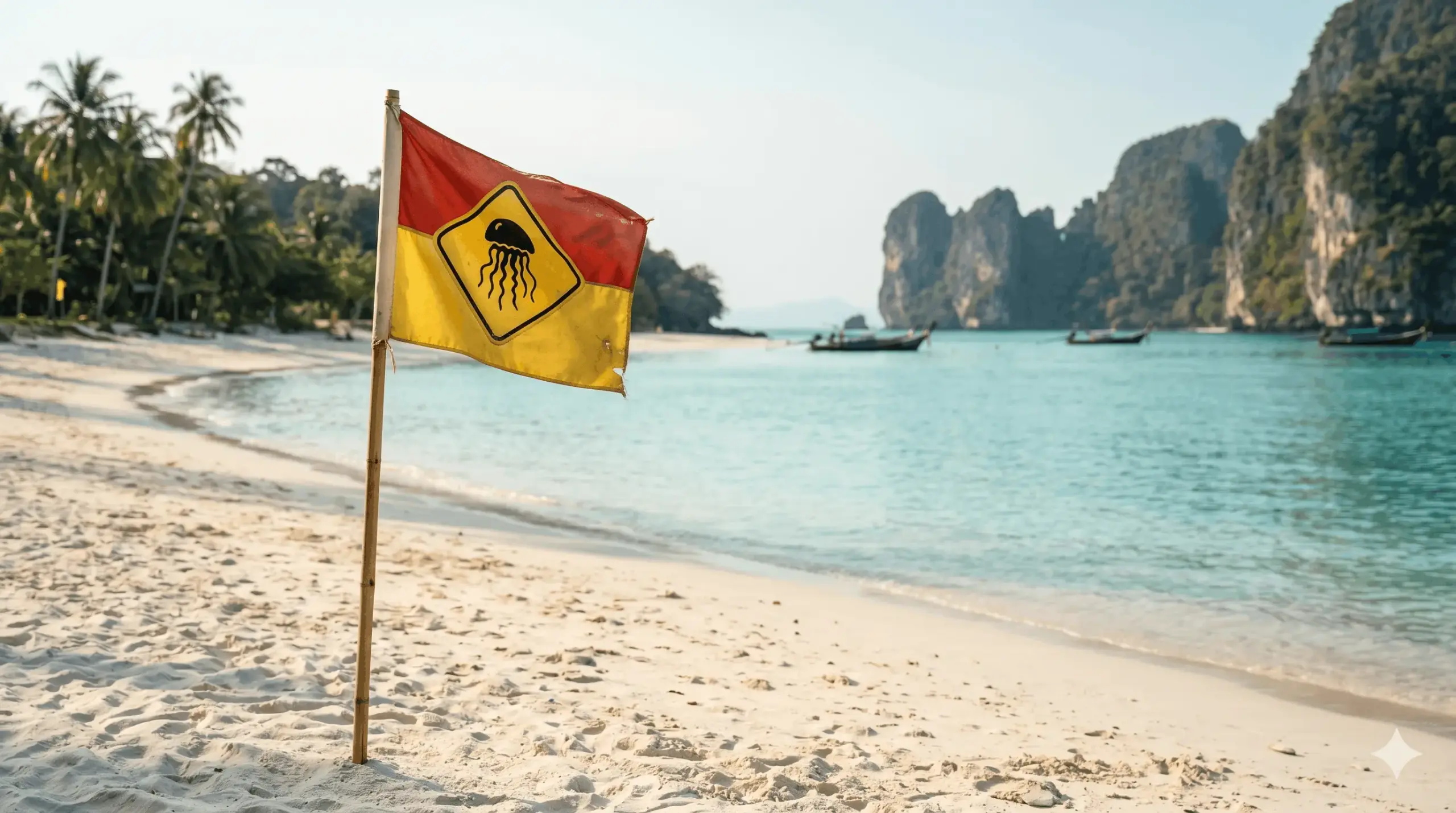
Short version: In April 2026 two separate waves of jellyfish were reported at popular islands near Phuket. At Racha Yai (Siam Bay): 20–30 moon jellyfish (Aurelia), mild stings causing skin irritation. At Koh Aeo: highly venomous fire jellyfish (Morbakka fenneri) at roughly 100 individuals per square meter at 3–5 metres depth, exactly the snorkeling zone. The fire jellyfish is significantly more dangerous: the sting causes severe pain and may require emergency care. Below: how to tell the species apart, which islands are currently being monitored, what to do if stung, and the mistakes you must avoid.
In 12 seasons on Phuket’s marine routes I’ve seen jellyfish «waves» 5–6 times, almost always during the April–May transition from dry to monsoon. In 2022 at Racha Yai we pulled three snorkelers out of the water in a single day with mild moon-jellyfish stings. April 2026 is more concerning: the species confirmed at Koh Aeo requires a serious first-aid protocol, not just a bandage and fresh water.
Key Takeaways
- Fire jellyfish location: Koh Aeo island, Phuket, reported by Travel And Tour World citing Thai authorities (April 15, 2026)
- Species: Morbakka fenneri, a box jellyfish, genus Morbakka, family Carybdeidae
- Density: ~100 individuals per m² at 3–5 m depth
- Moon jellyfish location: Racha Yai (Raya Yai), Siam Bay, DMCR / Nation Thailand (April 8, 2026)
- Species: Aurelia sp., moon jellyfish, sting is mild
- Do NOT: rinse with fresh water, rub the sting, or urinate on it
- DO: vinegar, then hot water 40–45 °C, then call 1669 (Thai emergency medical) for any systemic symptoms
Primary sources: Travel And Tour World — Essential Safety Advisory (April 2026); Nation Thailand — Moon jellyfish at Koh Racha Yai (April 8, 2026); Thailand Department of Marine and Coastal Resources (DMCR); box jellyfish background from the Australian Institute of Marine Science.
What Happened: Two Jellyfish Waves Near Phuket
According to Travel And Tour World (April 2026) and Thailand’s Department of Marine and Coastal Resources (DMCR), fire jellyfish (Morbakka fenneri) have been documented at Koh Aeo near Phuket at roughly 100 individuals per square meter at 3–5 metres depth, right in the snorkeling zone. This is significantly more serious than the moon jellyfish (Aurelia) waves spotted at Racha Yai on April 8, 2026.
April 8, 2026. DMCR issued an advisory about 20–30 moon jellyfish at Siam Bay on Racha Yai. A typical seasonal episode for April. Moon jellyfish stings are usually limited to localized skin irritation.
April 15, 2026. A second, more serious report emerged: dense concentrations of fire jellyfish Morbakka fenneri were confirmed at Koh Aeo (a small island within Phuket’s waters). Depth 3–5 metres, exactly where most boat-based snorkeling happens. Density about 100 individuals per m². For context: a normal season shows a handful of individuals across hundreds of metres of water.
So how bad is this in practical terms? These are two different species with very different risk profiles, and they should not be confused.
Fire vs. Moon Jellyfish: Species Comparison
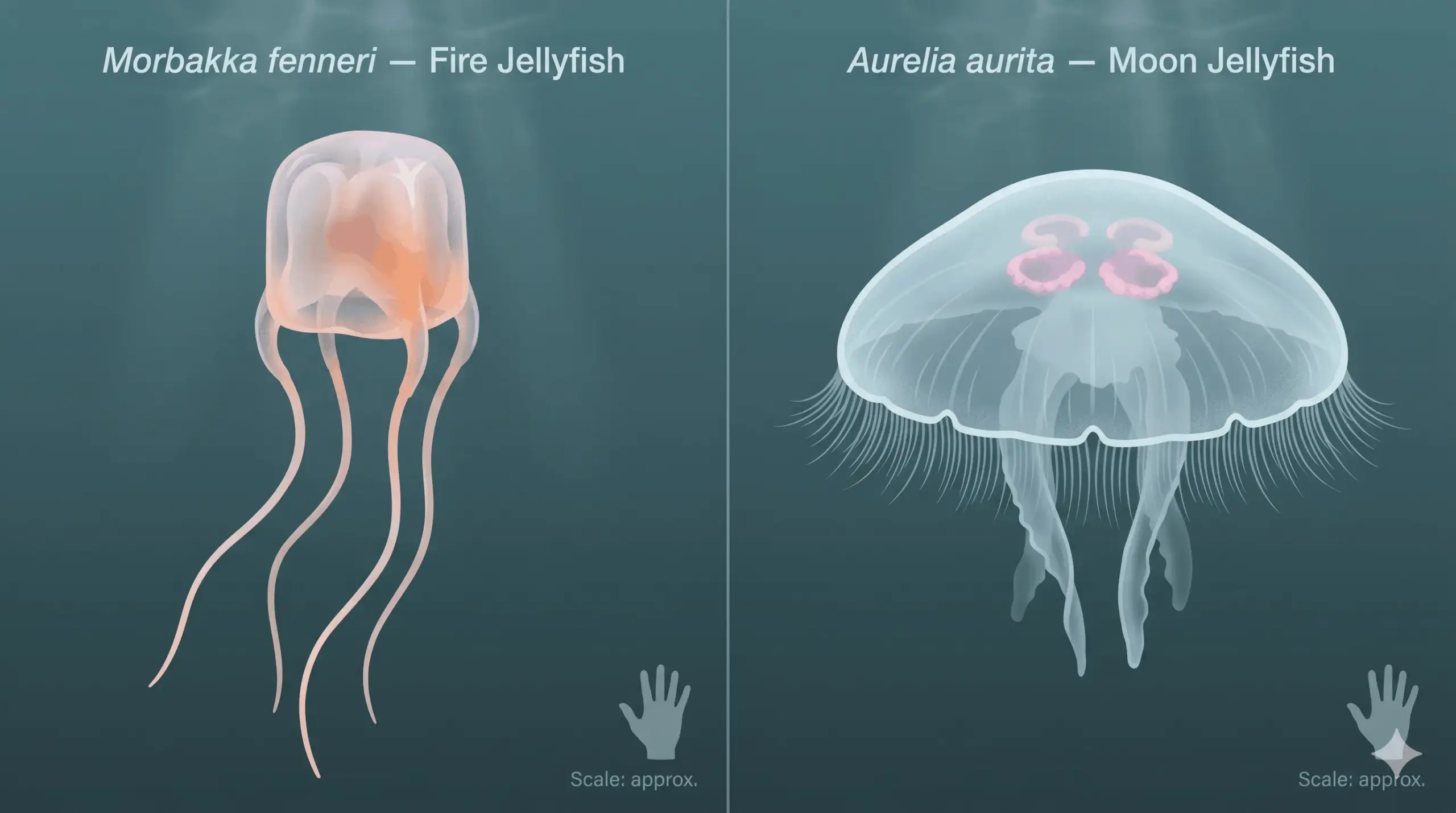
The fire jellyfish Morbakka fenneri is a box jellyfish and is significantly more dangerous than the moon jellyfish Aurelia. Its sting causes immediate severe pain, long-lasting red welts, and in rare cases systemic reactions requiring emergency care. The moon jellyfish is one of the least harmful species: stings feel like stinging nettles and typically fade within an hour.
| Feature | Fire jellyfish — Morbakka fenneri | Moon jellyfish — Aurelia sp. |
|---|---|---|
| Group | Box jellyfish (Cubozoa) | Scyphozoan jellyfish |
| Bell shape | Cube, roughly orange-sized, translucent pink | Flat round dome up to 30 cm, translucent with 4 pink rings |
| Tentacles | 4 long trailing tentacles, up to 1 m | Fine fringe around the dome edge |
| Sting sensation | Immediate severe burning pain, welts lasting days to weeks | Mild stinging-nettle burn, fades in 30–60 minutes |
| Systemic reactions | Possible: nausea, sweating, chest pain, Irukandji-like syndrome in severe cases | Very rare, only in cases of allergy |
| First aid | Vinegar → hot water → emergency services | Remove residue → hot water or ice pack |
| Emergency care needed | Yes, for any systemic symptoms | Only for severe allergic reactions |
So how painful is the sting in numbers? A practical note worth calling out: Morbakka fenneri is not «just a large jellyfish.» It belongs to a group that includes some of the most venomous animals on the planet (the Australian Chironex fleckeri is in the same order). Morbakka fenneri itself is less lethal, but on a pain scale it has been compared to an electric shock. In 2021 near Koh Kai I worked with a client who brushed one: pain onset was 2–3 seconds after contact and lasted 4 hours. The welts took 2 weeks to fade.
Phuket Islands Under Watch Right Now
As of April 16, 2026, the islands under active DMCR monitoring are the eastern side of Racha Yai (Siam Bay, moon jellyfish) and waters around Koh Aeo (fire jellyfish). Racha Noi, Coral Island, Maiton, and Phi Phi show no confirmed jellyfish blooms. The Similans are open until May 15, 2026 and have had no jellyfish reports this April.
Does this mean island tours are off? Not at all, most Andaman stops run normally. Current map of islands near Phuket as of April 16, 2026:
- Koh Aeo: fire jellyfish confirmed, water entry is not recommended. Not a mass-market stop, but some private yacht tours include it.
- Racha Yai, Siam Bay: moon jellyfish, 20–30 individuals. Snorkeling still possible with caution; guides monitor before each drop. Other Racha Yai bays (Ter Bay, Bungalow Bay): no incidents.
- Racha Noi: no reports. Deeper water, stronger currents, so jellyfish rarely accumulate here.
- Coral Island (Koh Hae): no reports. Popular snorkeling stop with 10–15 m visibility.
- Maiton, Lo Bay: no reports; dolphin program running normally.
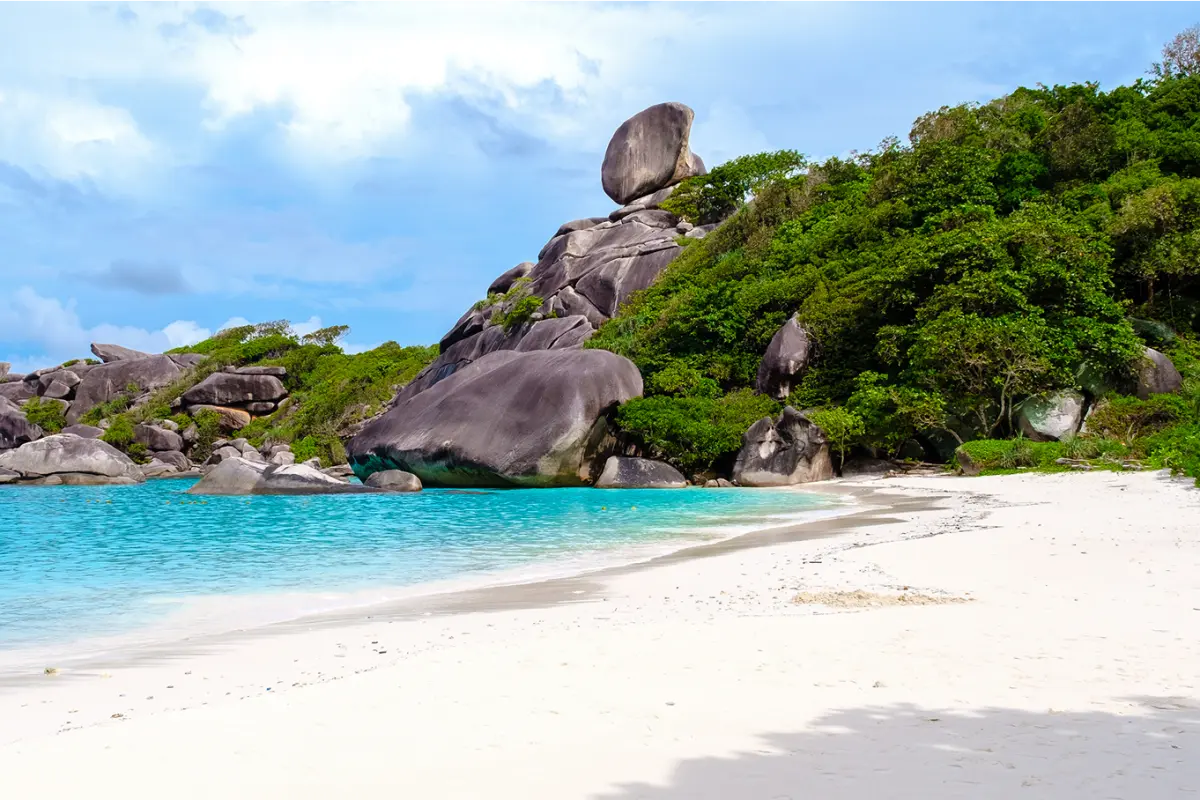
- Similan Archipelago: no jellyfish reports. The park is open until May 15, 2026 and then closes for monsoon season (full Similan closure breakdown).
- Phi Phi (Maya Bay, Pileh Lagoon, Bamboo Island): no reports in April 2026.
- James Bond / Phang Nga: no reports; the program runs mostly on kayaks in mangrove lagoons, very little snorkeling.
Our guides refresh this map every morning before heading out. If a stop is flagged on the day of your tour, the program shifts to an adjacent bay or island without losing the number of stops.
Jellyfish Sting First Aid — Step by Step
Standard jellyfish sting first aid in Thailand: exit the water calmly, do not rub the skin or rinse with fresh water. Remove tentacles with tweezers or a card, never bare hands. Apply vinegar (for box jellyfish) and then hot water at 40–45 °C for 30–40 minutes. For any systemic symptoms (nausea, weakness, chest pain, breathing difficulty), call 1669 (Thai emergency medical) immediately.
What do you do in the first 60 seconds after contact? Here is the step-by-step.
If a fire jellyfish (Morbakka fenneri) stings you, or you are not sure which species it was
- Leave the water calmly, do not panic. Panic raises your heart rate and spreads the venom faster.
- Do not rub the sting site. Rubbing fires any remaining stinging cells.
- Remove tentacles. Use tweezers, a credit card, or the edge of a mask. Never bare hands. Never fresh water.
- Apply vinegar (5% acetic acid) for 30 seconds. Vinegar deactivates the stinging cells of box jellyfish. Every Tisland boat carries vinegar in its first-aid kit.
- Hot water at 40–45 °C for 30–40 minutes. Heat breaks down the protein-based toxins. If no hot water is available, use fresh water at the warmest comfortable temperature from a thermos.
- Call 1669. Free emergency medical hotline in Thailand; operators speak English. For systemic symptoms, go to hospital: Bangkok Hospital Phuket or Phuket International Hospital.
If a moon jellyfish (Aurelia sp.) stings you
- Leave the water, don’t rub.
- Rinse residue off with seawater (not fresh water).
- Apply warm water or an ice pack wrapped in cloth, whichever is more comfortable.
- Antihistamine or lidocaine cream if available.
- See a doctor only for strong allergic reaction or unusual symptoms.
What to Never Do
- Do not rinse with fresh water. The osmotic difference fires any remaining stinging cells.
- Do not rub with sand, towel, anything.
- Do not urinate on the sting. A myth popularized by Friends. Urine contains salts that behave exactly like fresh water, increasing pain.
- Do not apply ice directly. Only through cloth.
- Do not give alcohol «for anesthesia.» Alcohol raises heart rate and accelerates venom spread.
How We Run Tours in April 2026
Tisland Travel tours in April 2026 run normally: Racha Yai adjusted to the jellyfish situation (snorkeling moved to safe bays), Similans open until May 15, Phi Phi and Coral Island unrestricted. Every boat carries a first-aid kit with vinegar, tweezers, and a thermos; the guide briefs the group before the first drop.
So how does this look from inside, on the day of a tour? In 16 years on Phuket we’ve developed a simple protocol: before every departure the senior guide checks the DMCR and Marine National Park morning bulletin. If a stop is flagged, we shift to another bay on the same island or to a neighboring island. Standard redirects as of April 16, 2026:
- Snorkeling planned at Siam Bay (Racha Yai) → move to Ter Bay or Bungalow Bay.
- Private charter requested to Koh Aeo → suggest Racha Noi or Coral Island instead.
- Any snorkeling stop → before the first drop the guide enters the water and visually checks 3–5 m depth for jellyfish.
Always on board:
- 5% vinegar (standard table vinegar), at least 500 ml.
- Tweezers and a spare plastic card for tentacle removal.
- Thermos of hot water (not boiling) for compresses.
- First-aid kit with antihistamine and lidocaine cream.
- 1669 and the nearest hospital’s WhatsApp contact saved in the guide’s phone.
What if you’re on a tour with another operator? Ask the guide directly before departure whether the boat carries vinegar and a thermos. Good operators answer immediately.
FAQ: Phuket Jellyfish, April 2026
Should I cancel my tour because of jellyfish?
No. The only reason to cancel is if your tour’s only stop is Koh Aeo and you won’t accept a replacement. Every other route (Racha Yai with a bay swap, Similans, Phi Phi, Coral Island, James Bond) is running normally. Tisland guides adjust snorkeling spots in real time.
How do I tell a fire jellyfish from a moon jellyfish in the water?
The moon jellyfish is flat, translucent, like a 20–30 cm «plate» with four pink rings inside. The fire jellyfish Morbakka fenneri is a cube-shaped bell roughly the size of an orange, with 4 long trailing tentacles. Moon jellyfish are visible from a distance and move slowly. Fire jellyfish are more transparent, move actively, and often stay at 3–5 m depth.
Does urine help a jellyfish sting?
No. It’s a myth. Urine behaves exactly like fresh water: it triggers the same negative effect of firing remaining stinging cells and intensifying the pain. There is no scientific support. Use vinegar or warm seawater.
How long do fire jellyfish sting marks last?
Acute pain: 2–4 hours. Red whip-like welts: 1–3 weeks. Darker pigmented marks can remain for several months. In rare cases systemic symptoms (Irukandji-like syndrome) appear 20–40 minutes after the sting: nausea, chest pain, sweating, anxiety. In that case, call 1669 immediately and go to hospital.
Is there a jellyfish season in Phuket?
Peaks: April–May (monsoon transition) and October–November (exit from monsoon). Fewer jellyfish in summer, but isolated cases occur year-round. The season shifts yearly: in 2023 the first wave came mid-May; in 2026 it arrived in the first half of April.
What insurance covers a jellyfish sting?
A standard tourist medical policy covers hospital visits and medication after a sting. All Tisland marine tours include on-tour accident insurance. For full hospital transfer with IV drips, a policy with medical evacuation helps.
Can a wetsuit protect me from jellyfish?
Partially. A Lycra rashguard or a thin 0.5–1 mm shorty covers 70–80% of skin and significantly reduces contact risk. Tisland boats carry free Lycra tops for guests during jellyfish season. Face and legs still remain exposed, so protection is not complete, but the sting statistics for rashguard users are much lower.
What to Do Right Now
If you have a marine tour planned this week in Phuket, don’t cancel, clarify. Which islands are included, does the boat carry a first-aid kit with vinegar and a thermos, is the guide ready to shift snorkeling spots if the morning bulletin flags your planned stop? For Tisland tours the answers are yes, yes, and yes.
If you’re still booking, look at Tisland marine tours from Phuket: programs at Racha Yai, Coral Island, the Similans (until May 15), Phi Phi, and James Bond. Not sure which is safest this specific week? Write to us and a senior guide will share the morning status for each island.
And save number. 1669: free Thai emergency medical hotline, English-speaking operators.
Sources: Travel And Tour World — Essential Safety Advisory on Moon Jellyfish Season at Phuket’s Racha Yai (April 2026, expanded with Koh Aeo data); Nation Thailand — Moon jellyfish spotted near Koh Racha Yai, tourists warned (April 8, 2026); Thailand Department of Marine and Coastal Resources (DMCR) — daily bulletins for the Phuket coast; Australian Institute of Marine Science — reference material on box jellyfish and Irukandji syndrome; Thai Emergency Medical Institute — jellyfish sting first-aid protocol and the 1669 emergency number. All facts in this article, outside the author’s personal experience, are supported by the cited sources as of April 16, 2026.