
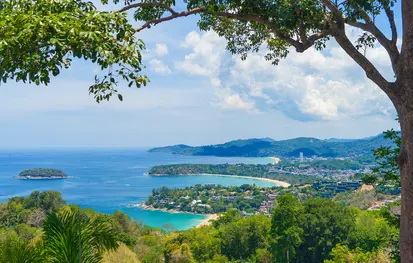






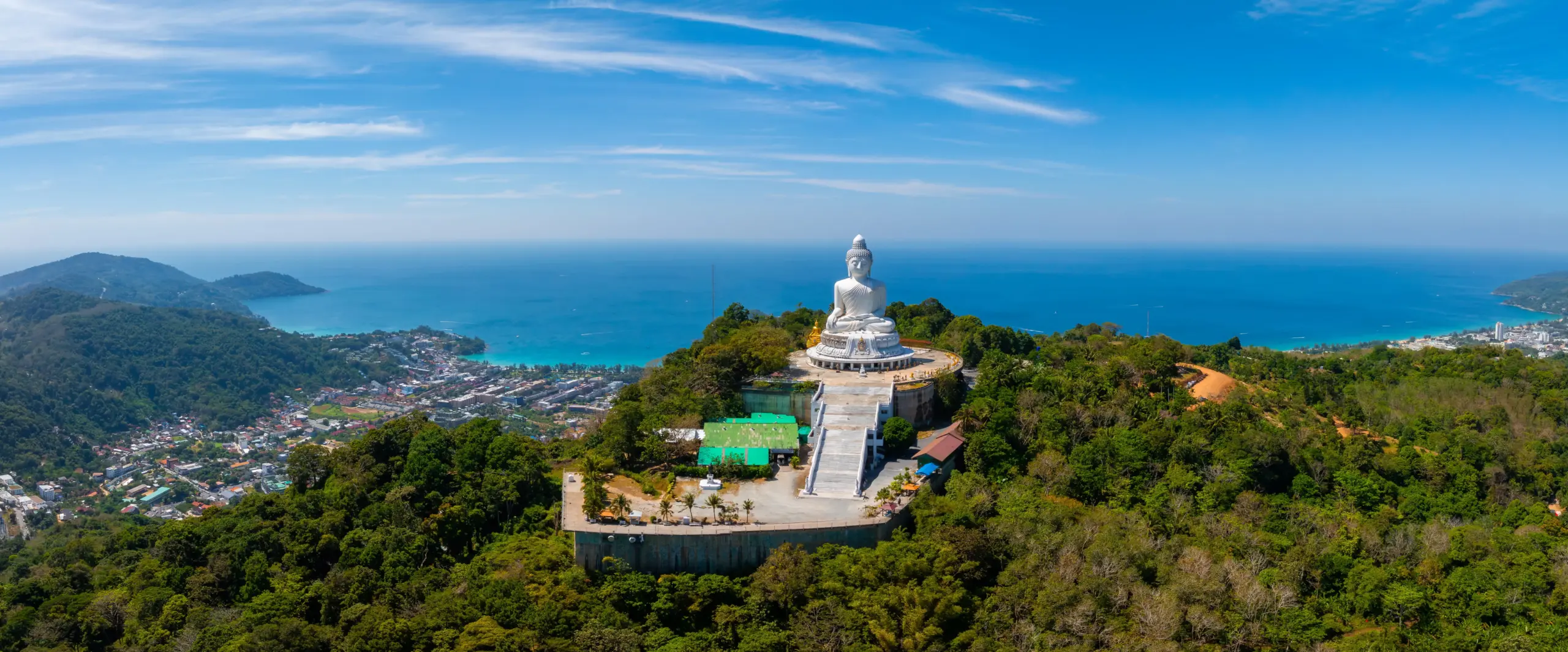
On the southern tip of Phuket, between Chalong Bay and Kata, sits a hill called Nakkerd. On a clear day its summit gives you half the island at a glance: sweeping beaches, white yachts at anchor, the green backs of other hills, and the endless Andaman Sea. Above it all, facing Chalong Bay, sits a snow-white 45-meter Buddha, the statue locals just call «the Big One.» Its story is short but quietly human. The whole world has been building it together for more than twenty years.
Quick facts about the Big Buddha
Phuket’s Big Buddha is a 45-meter seated statue on Nakkerd Hill, clad in white Burmese marble. Its formal name is Phra Phutta Mingmongkol Eknakiri, which translates as «The Auspicious Buddha on Nakakiri Mountain» (Wikipedia). The key parameters:
- Where: Nakkerd Hill (Nakkerd, sometimes Nagakerd), southern Phuket, between Chalong, Kata, and Rawai.
- Foundation year: 2004.
- Size: 45 m tall, 25.45 m wide at the base (Wikipedia).
- Materials: reinforced concrete frame, Burmese jadeite white marble cladding.
- Formal name: Phra Phutta Mingmongkol Eknakiri, «The Auspicious Buddha on Nakakiri Mountain.»
- Budget: roughly 30 million baht, raised entirely through donations (Renown Travel).
- Buddha’s gesture: bhumisparsha mudra, right hand touching the earth, left hand resting on the knee.
A full source list is at the end of the article.
The hill that shows you half of Phuket
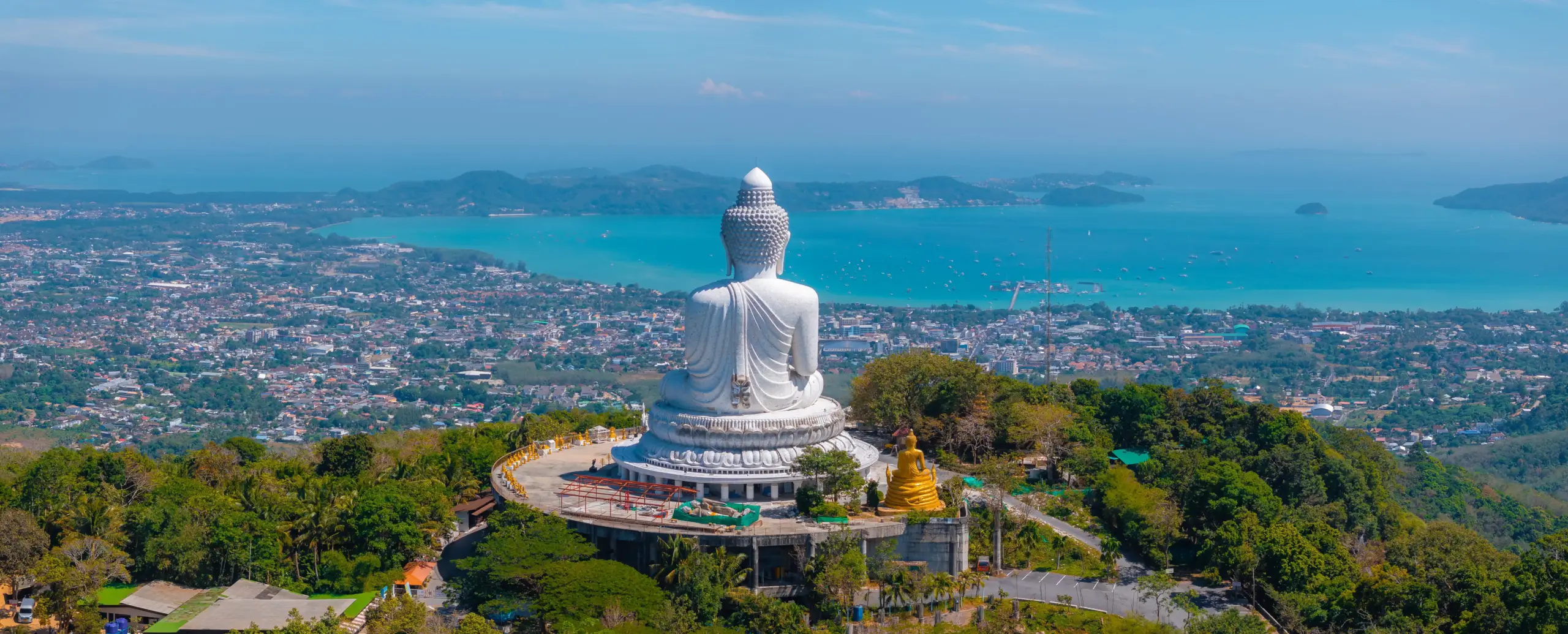
Nakkerd Hill rises to about 400 meters above sea level and ranks among the three best viewpoints in southern Phuket (GPSmyCity). It isn’t the island’s highest point, but it’s one of the most visible. The white figure of the Buddha can be seen from the beaches of Kata and Chalong and serves as a landmark for tourists and local fishermen alike.
The road to the summit winds in tight switchbacks through jungle: rubber trees, hevea groves, the occasional stand of bamboo. Cars and scooters climb slowly, which is a gift, because you get to watch the light and air change. A few hundred meters more and the forest pulls back, and the white figure seems to grow straight out of the sky.
The statue faces Chalong Bay. Construction began in 2004, the same year Phuket was struck by the Indian Ocean tsunami in December, a disaster that killed more than 5,000 people in Thailand alone (Wikipedia: 2004 Indian Ocean tsunami). The coincidence of dates isn’t recorded in any official project document, but it has taken firm root in the island’s oral tradition. Guides on Nakkerd almost always tell visitors that the white figure above the bay is part of Phuket’s memorial to the people who could not be saved.
How a temple gets built coin by coin
The Big Buddha is one of the few temples in Thailand built entirely on micro-donations. According to the temple administration, more than 70% of the budget comes from contributions between 100 and 500 baht (Renown Travel). In Thai tradition, giving to a temple means «making merit» (tam bun), accumulating good action that returns to you in this life and the next.
Work on the statue began in 2004. The project had no single wealthy patron. Instead, it had a long list of small contributions. Local residents gave 100 to 500 baht at a time. The Thai royal family supported the project with its own donation. Companies joined in, then visitors from the region and further afield, from Malaysian neighbors to Russians and Europeans who came up to Nakkerd between beaches and ended up staying longer than planned.
Money doesn’t arrive all at once. The construction lives at the pace of donations. Funds come in, another row of marble panels goes up. A sponsor appears, the altar gets a refresh. That’s why the Big Buddha can’t be called a «finished» monument even now. Something is added every year: a pavilion, a temple stairway, new frescoes in the lower hall. Total construction cost has already passed 30 million baht and continues to grow.
For anyone visiting Phuket on holiday, it’s a rare and quietly moving opportunity. You get to see a living temple, not one that was built long ago and is only being restored, but one that is still growing in front of you, coin by coin.
The gesture that explains everything
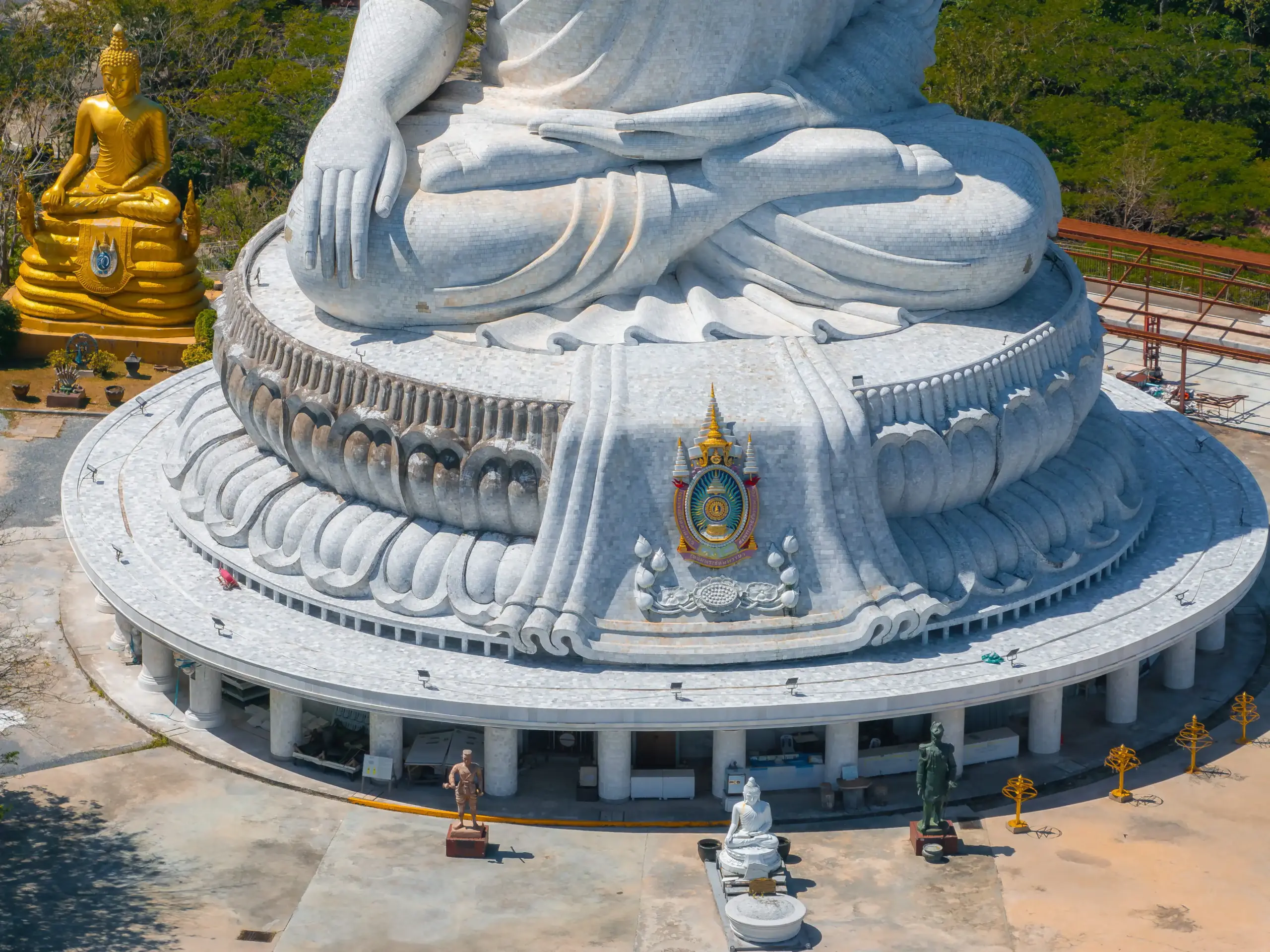
The Buddha’s pose is the bhumisparsha mudra, «calling the earth to witness.» The right hand drops down and its fingers touch the ground, the left hand rests on the knee (HD Asian Art). It’s one of the most common gestures in Buddha iconography. In catalogs of Buddhist art, it appears on more than 40% of seated Shakyamuni statues across Southeast Asia (Original Buddhas).
Look closely at the Big Buddha and his pose differs almost imperceptibly from the familiar «statue with hands folded in the lap.» The left hand rests calmly on the knee. The right hand drops down, fingers brushing the earth. Behind that small movement sits a whole legend.
In the Buddhist tradition, on the eve of his enlightenment, Prince Siddhartha sat in meditation under the Bodhi tree. The demon Mara, an embodiment of doubt, fear, and desire, came to unsettle him. He sent an army, his own beautiful daughters, and false visions. When Mara demanded to know who could witness Siddhartha’s right to awakening, the prince didn’t argue. He lowered his right hand in silence and touched the earth, and the earth answered, confirming that he was worthy of enlightenment. Mara was shamed. Siddhartha became the Buddha.
So the right hand of the Big Buddha on Nakkerd reaches toward the earth. He still seems to be making that gesture today, calmly and without display, like someone who no longer has anything to prove.
Marble tiles of wishes: how to leave your mark
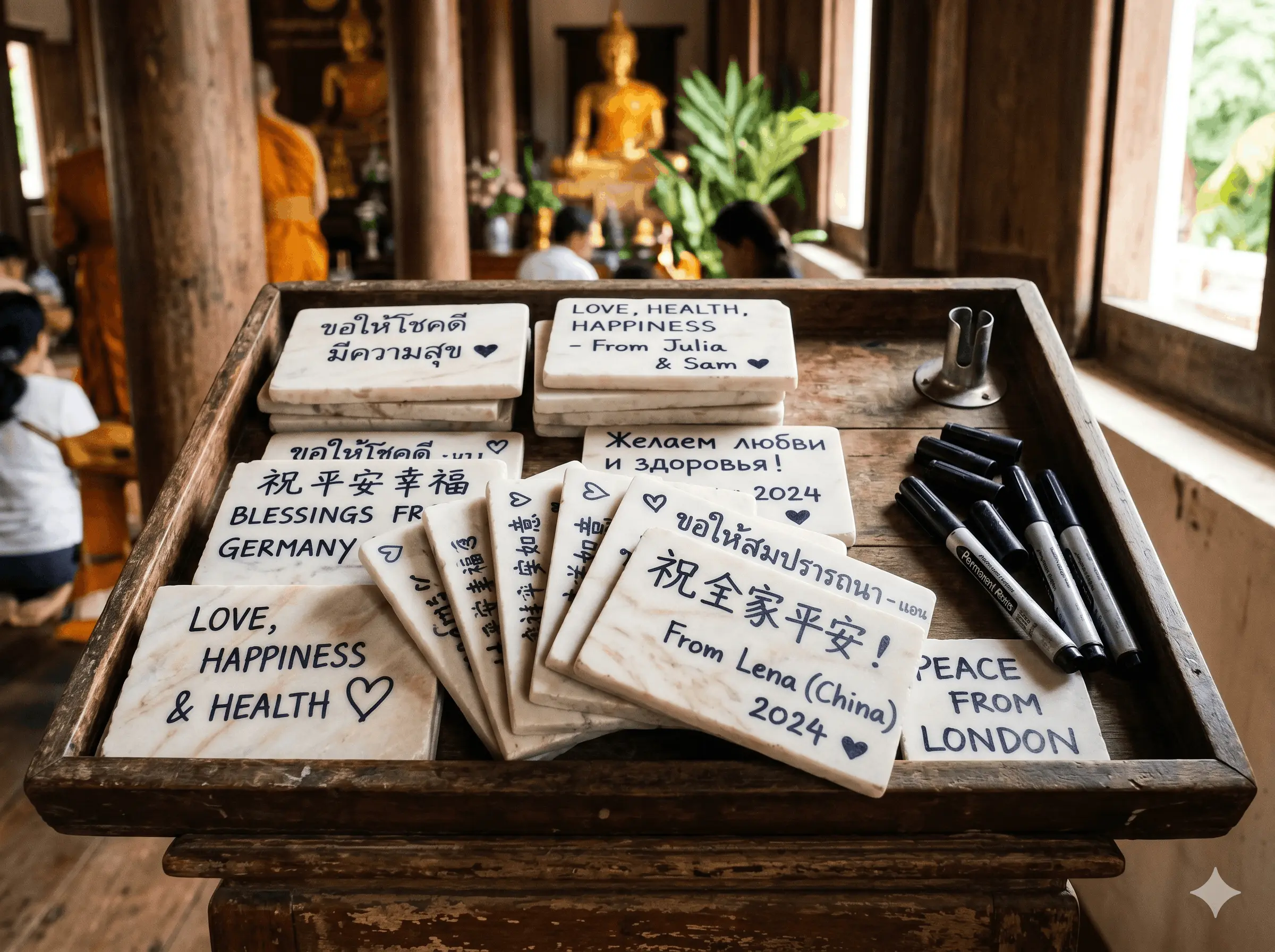
A marble tile with a written wish costs 100 baht (about $2.70), which is the most accessible way to join in the construction. Your inscribed tile will be physically set into the wall of the statue or one of the pavilions. In our own observation, during high season from December to February, the wish table at the temple handles about 400 to 600 tiles per day.
Near the table where people write their wishes, markers are always quietly rustling across stone. People write in Thai, English, Chinese, Russian, sometimes drawing small hearts or the character 福 for «fortune.» Tourists often sign a tile for the whole family: «Health for mom,» «Katya and Igor, anniversary 2024,» «Grow strong, little one.» Some come back a year later, with children, and write a tile from two names.
These tiles are an unusual souvenir. You can’t take one home. But there are others you can. The temple pavilion sells woven bracelets blessed by monks, small Buddha figurines, incense, and amulets. Every purchase is also a contribution to the construction, just wrapped a little differently.
Three recurring scenes at the Big Buddha
The scenes below aren’t specific stories but recurring pictures our guides see on Nakkerd week after week. We’ve deliberately left out names. This is the everyday backdrop of the temple, not a cast of characters.
Couples coming back after a few years. We often meet visitors who first came here as students and left a tile with a dream written on it: «We’ll get married,» «We’ll build a house,» «We’ll move to Asia.» Five or eight years later they return, with a child or a wedding ring, and write a new tile. The guide usually recognizes them by the opening line: «We were here about eight years ago.»
Locals on scooters. Plenty of Thai visitors stop at Nakkerd on a Friday or Saturday, briefly, for five or ten minutes. They bow, leave flowers, buy a small bottle of blessed water. For them this isn’t a sight. It’s a regular stop on the route, closer to a quick visit to a neighborhood church on the way home from the market.
Solo travelers. We regularly see guests who sit near the statue for an hour or longer. They don’t walk around. They don’t take photos. They don’t write anything. They just look at the bay. The temple staff stopped being surprised a long time ago. People often come to the Big Buddha precisely for that.
Everyone arrives with a different level of faith. But the space around Nakkerd is generous enough for all of them, for the pilgrim and for the visitor who meant to take a quick look and stayed to breathe.
What to know before your visit
Entry is free, but this is a working Buddhist site. There’s a dress code, a few rules of behavior, and a donation box in every pavilion (GPSmyCity). Nothing is difficult, yet without a little preparation you can stand out awkwardly.
- Clothing. Shoulders and knees covered. Sarongs are handed out free at the entrance if you arrive in shorts or a tank top.
- Shoes. Remove them before entering any pavilion. Slip-on sandals are easiest.
- Conduct. Speak softly. Don’t turn your back to the statue for a photo. Don’t point at the Buddha with your feet.
- Donations. Boxes are placed in every room. Any amount works, starting at 20 baht. No entry ticket is needed.
- Best time. Early morning, 8:00 to 9:30, or about ninety minutes before sunset. Fewer people, softer light, and the marble shows its veining clearly.
How to get there
The Big Buddha is about 15 minutes by road from Chalong, 25 to 30 from Kata or Karon. The last 6 km are a narrow switchback climb with about 400 m of elevation gain (GPSmyCity), so your choice of transport matters.
- By car or scooter. The turn off Route 4028 toward «Big Buddha Phuket» is clearly signed. The last 6 km are narrow switchbacks, and a scooter really asks for confident handling.
- With a guide. Tisland includes the Big Buddha in three different southern-Phuket tours. Details are below, under «How to visit the Big Buddha with Tisland.»
- By taxi or Grab. Roughly 500 to 700 baht one way from Patong. Arrange in advance for the driver to wait. Walking back down is hard, and traffic is thin.
Parking is free. Water and fruit are sold on site, but prices are above the island average. That’s part of the donation too.
Frequently asked questions
Do you have to be Buddhist to visit the Big Buddha?
No. The temple is open to anyone. You just need to follow the dress code and be calm and quiet. No ceremonies, prayers, or declarations of faith are expected from visitors.
Can you take photos near the statue?
Yes, photos are allowed everywhere except the altar room beneath the statue, which is signed. The one rule: don’t turn your back to the Buddha, and don’t pose with your feet «pointing» at the image. In Thai tradition that’s a sign of disrespect.
How much does a wish tile cost?
Standard price is 100 baht for a single marble tile. You can buy several, for example one per family member. Markers are provided on site.
When will the Big Buddha be finished?
There’s no target date. The statue has stood in its final form since 2008, but the inner halls, mosaics, and surrounding pavilions keep being updated as donations arrive. It’s a conscious design. The temple is «always on the way.»
Is there a connection between the statue and the 2004 tsunami?
The project was conceived earlier. But for locals the coincidence between the construction start and the disaster has taken on spiritual meaning. The Big Buddha has become part of the island’s memory and a symbol of recovery. This is oral tradition, not the official motivation for building.
What are the opening hours?
The grounds are open every day from 6:00 to 19:30. Interior rooms are open from 8:00 to 17:30. Access to the altar halls may be restricted during Buddhist holidays.
Is it worth visiting in the rainy season?
Yes, though the switchbacks get slippery. From May through October, aim for morning trips. Afternoon showers are common. There’s no shelter on the viewing deck apart from the pavilions.
How to visit the Big Buddha with Tisland
Riding up by scooter is romantic, but forty minutes of switchbacks under tropical sun with no context isn’t for everyone. Tisland runs three different tours to the Big Buddha with a Russian-speaking guide, an air-conditioned minivan, hotel transfer, and insurance. Groups are small, 6 to 11 people, so you don’t land in the crowd at Nakkerd and you have time to hear the stories behind the tiles, the mudra, and the 2004 tsunami from someone who has been working the hill for years, not from the internet.
«Real Phuket» sightseeing tour, for travelers who want the whole island at once
An eight-hour route through southern and central Phuket: Karon Viewpoint, Rang Hill, the Big Buddha on Nakkerd, the PH+ snake farm with a cobra show, the old town of Phuket Town with its Sino-Portuguese architecture, and Khao Rang temple complex. Departure at 8:00 puts you at the Buddha in soft morning light, before the marble heats up. Price is 1,200 baht per person, including transfer, guide, and insurance.
A good choice for a first Phuket visit, when you want the headline sights in one dense day, from Buddhist symbolism to the old trading streets.

Buddha + shopping tour, temple in the morning and shopping after
An 8 to 9 hour tour for travelers who want to pair a visit to the Big Buddha with the practical side of the holiday. The route: the Big Buddha on Nakkerd, the royal Moringa pharmacy, Princess Jewelry workshop, a latex factory (mattresses and pillows), the snake farm with its cobra show, Central Festival mall, and a walk through old Phuket Town. Price is 900 baht per person, the cheapest way to reach the Buddha with a guide.
A good fit for families with children from age 5 and for anyone who wants to bring home not just photos but actual purchases: jewelry, skincare, textiles, without getting caught by tourist markups.

«Real Phuket» + Saturday night market, a day that ends at sunset with street food
An extended ten-hour version of the sightseeing tour. On top of the «Real Phuket» route (Big Buddha, snake farm, old Phuket Town, Rang Hill, Khao Rang temple) you get an evening at the well-known Naka Weekend Market from 18:00 to 20:00: street food, local sweets, craft stalls, Thai musicians. Price is 1,500 baht per person, with free cancellation up to 48 hours before.
Pick this one if you’re on Phuket for a short stay and want to see both the spiritual side of the island and its street life in a single day. You reach the Big Buddha around midday, in the «thickest» light, when the white marble almost glows against the blue of the bay.

Which tour to choose
| Tour | Duration | Best for |
|---|---|---|
| Real Phuket | 8 h | One packed day, the main views |
| Buddha + Shopping | 8 to 9 h | Families with kids, shopping list |
| Real Phuket + Saturday Market | 10 h | Short stays, street-market lovers |
On all three routes the Big Buddha isn’t a box-ticking stop. It’s a full segment, with enough time to climb up to the statue, visit the lower hall with its frescoes, write a tile, and sit quietly with the view of Chalong Bay.
What you take away from Nakkerd
With you: a couple of photos of Chalong Bay, a bracelet from the monks, maybe a small Buddha figurine. Inside: a little more quiet than you had on the way up. And, perhaps, a single marble tile that will one day be set into the Buddha’s wall under someone’s soft «may all be well.» On Nakkerd Hill that system has worked for more than twenty years, one tile at a time.
About the author
This article was prepared by the Tisland guide team on Phuket. We’ve been running tours to the Big Buddha since 2016 and update this text after seasonal visits to the hill, most recently in April 2026. Spotted an inaccuracy? Write to hello@tisland.travel and we’ll fix it.
Sources
- Phuket Big Buddha, Wikipedia
- 2004 Indian Ocean earthquake and tsunami, Wikipedia
- Big Buddha Phuket, 45 Meter tall Buddha image (Renown Travel)
- Phuket Big Buddha, Phuket (GPSmyCity)
- Explanation of the Bhumisparsha mudra (Original Buddhas)
- The Bhumisparsha Mudra: Touching the Earth in Witness (HD Asian Art)