









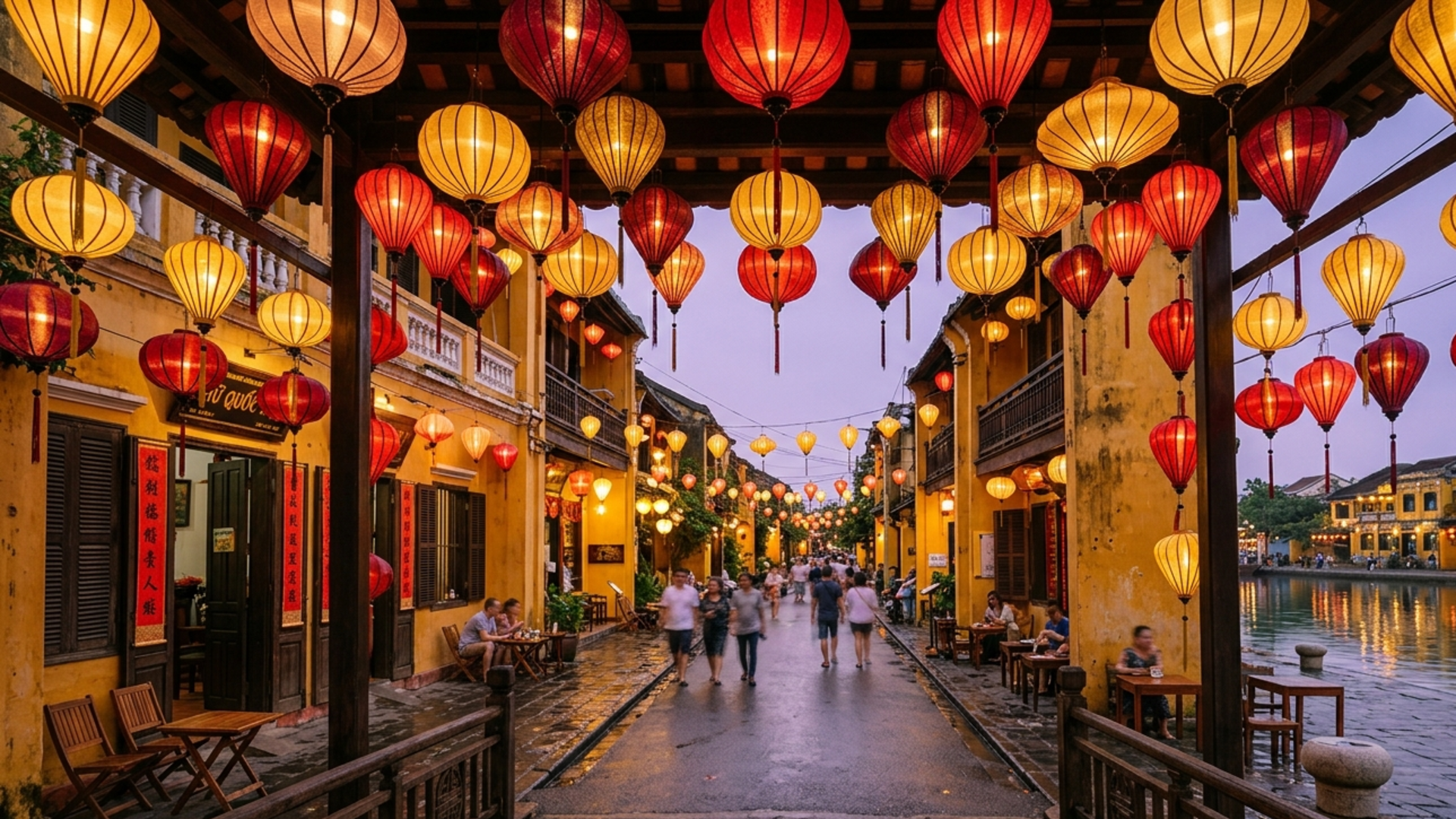
Vietnamese lucky colors greet travelers the moment they step off the plane: red on the national flag, red on welcome banners, red lanterns along the arrivals hall. Furthermore, if you visit during a festival, the question arises on its own. Why is everything red and yellow? For example, red lanterns hang over the streets of Hội An. Moreover, red envelopes appear in children’s hands, yellow flowers in every home at Tết, and red tablecloths at weddings. Even the national flag is red with a yellow star. However, this is not random décor or a tourism prop. In fact, it is a system more than a thousand years old.
The short answer: Vietnamese lucky colors are red and yellow — red stands for happiness, fortune and protection from evil spirits, while yellow signals imperial grandeur, nobility, and prosperity. Locals read this code instantly. Therefore, if you want to give the right gift or pick the right outfit for a celebration, understanding the colors is essential.
1. Red in Vietnam: happiness, luck, and protection
Red is the cornerstone color of the Confucian cultural sphere across East Asia. Moreover, in Vietnam it works the same way it does in China and Korea: it stands for luck, joy, well-being, and protection against negativity. Additionally, red is believed to scare off evil spirits and draw in positive energy.
That is why the key moments of a Vietnamese life are painted red. For example, at weddings the bride traditionally wears a red áo dài, guests receive red gift boxes, and the table is dressed in red linens. However, the white dress is a recent Western influence, and brides often change outfits during the day: Western white for the formal ceremony, traditional red for the family banquet.
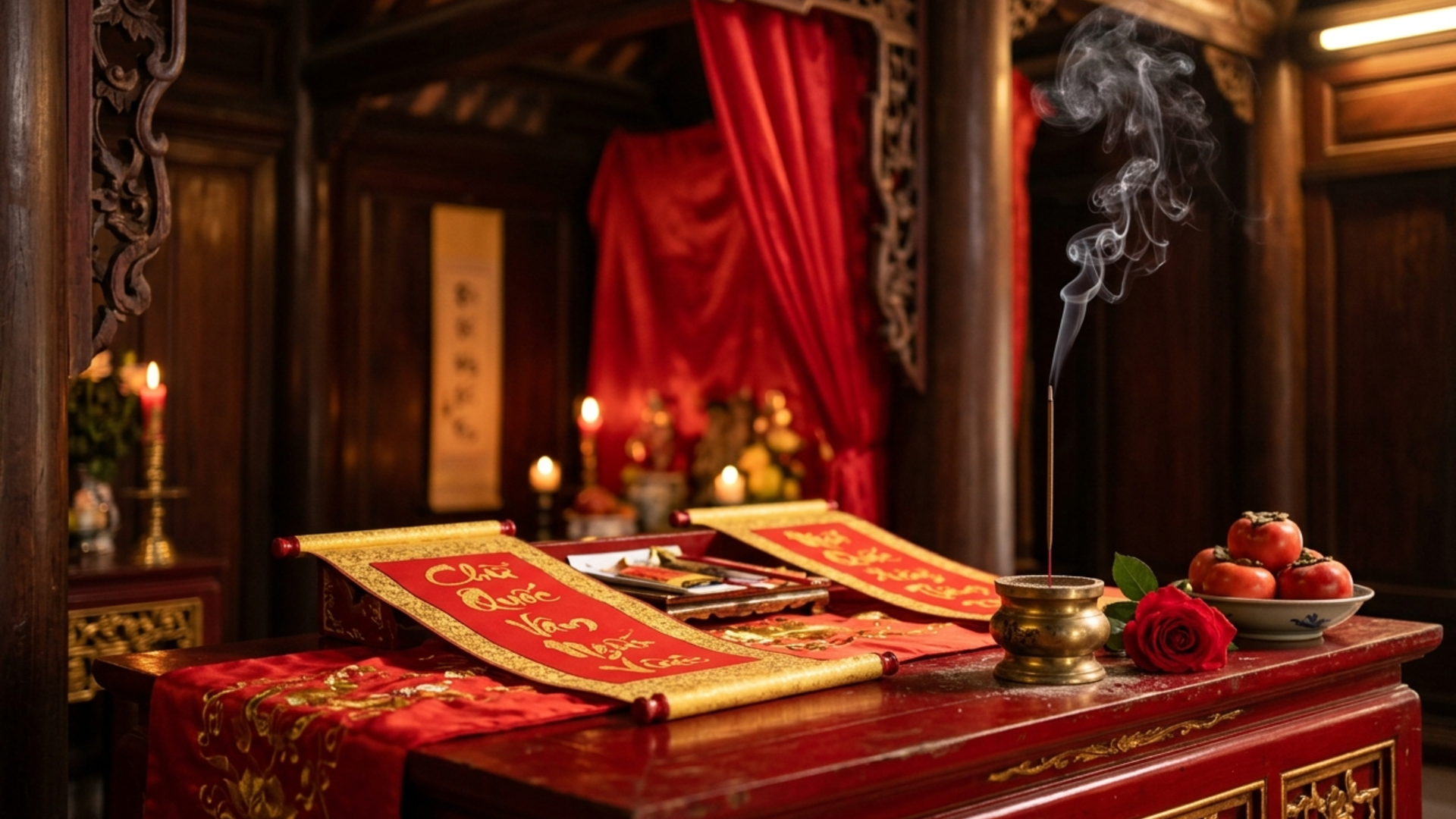
Similarly, at business openings red ribbons and red signboards with wishes go up over the door. In addition, a family that has just moved in adorns the entrance with red parallel inscriptions (câu đối) carrying good-fortune wishes. Likewise, ancestral altars in homes are often draped in red, expressing respect for ancestors and asking for their protection.
On the other hand, there is a flip side: red is never worn at funerals. Indeed, that would be a serious breach of etiquette. Instead, white and black do the work of mourning here — the colors of grief, opposite to the joy of red. Thus, the Vietnamese lucky colors are always context-bound. In short, red is celebratory, never funerary.
2. Yellow: the color of emperors and nobility
If red is the people’s color of joy, yellow is the color of power. Specifically, until the monarchy fell in 1945, only members of the ruling Nguyễn dynasty had the right to wear yellow garments in Vietnam. Moreover, a commoner in yellow was unthinkable — by etiquette and by law.
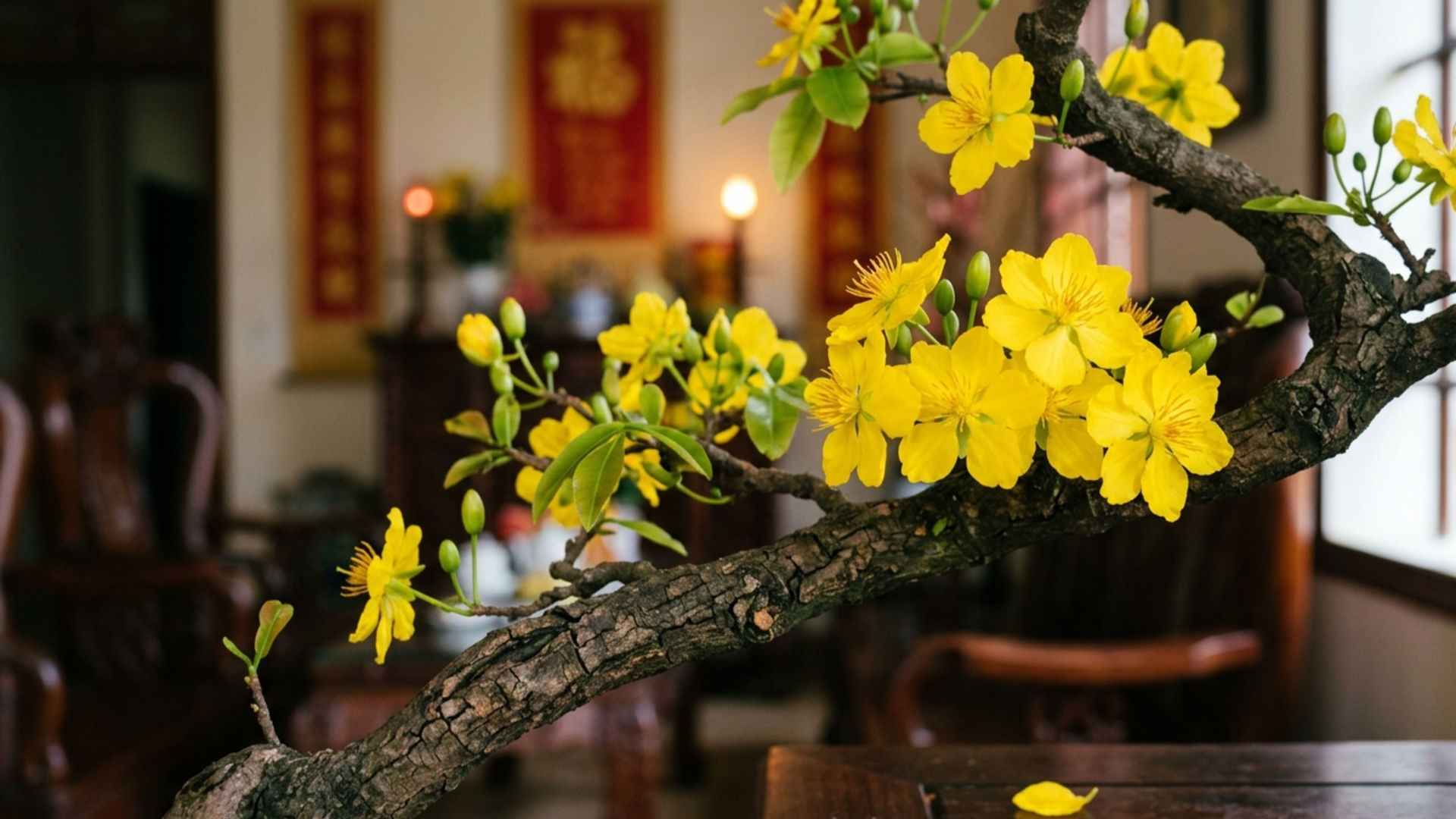
In addition, yellow carried associations with gold, the sun, and earth (the center of the world under the five-elements system) — and by extension with the emperor as the center of the state. For instance, the Đại Nam Nhất Thống Chí, compiled by Nguyễn dynasty historiographers, records that the yellow apricot, «hoàng mai,» was the imperial court’s favored tree at the old capital of Huế, and its five-petal blossom was embroidered onto formal court robes.
After 1945, yellow lost its monopoly but kept its status. Today, however, it appears wherever a «noble» accent is needed:
- The yellow star on the red flag of the Socialist Republic of Vietnam — symbolism uniting the two colors of luck and power.
- Yellow hoa mai blossoms at Tết in southern Vietnam — a sign of prosperity.
- Yellow robes of Buddhist monks — the nobility of the spiritual path.
- Yellow decorations at weddings, usually paired with red — gold, wealth, abundance.
Moreover, modern Huế even hosts a dedicated Hoàng Mai festival, the «festival of the yellow apricot,» that draws thousands every spring. As a result, this is no longer a tribute to emperors — it has become part of the local identity.
3. When Vietnamese red and yellow meet
The bigger the occasion, the denser the red-yellow code. For example, weddings, the New Year, business openings, anniversaries, and ancestor commemorations all call for both colors together. In fact, the logic is simple: red brings happiness, yellow brings wealth. Therefore, together they make the moment doubly blessed.
Moreover, a traveler bumps into this pair at every corner:
- In temples and pagodas — red columns and yellow wall paintings.
- In the souvenir lanes of Hội An — red lanterns with yellow tassels.
- In restaurants before Tết — souvenir red envelopes next to yellow apricot branches.
- At markets — red wishing packets and yellow tea wrappers.
If you see a shop or restaurant lit up in pointedly bright red and yellow, it is either preparing for a major festival or celebrating a grand opening. In other words, the owner is asking fortune for both.
4. Tết and the lì xì red envelope
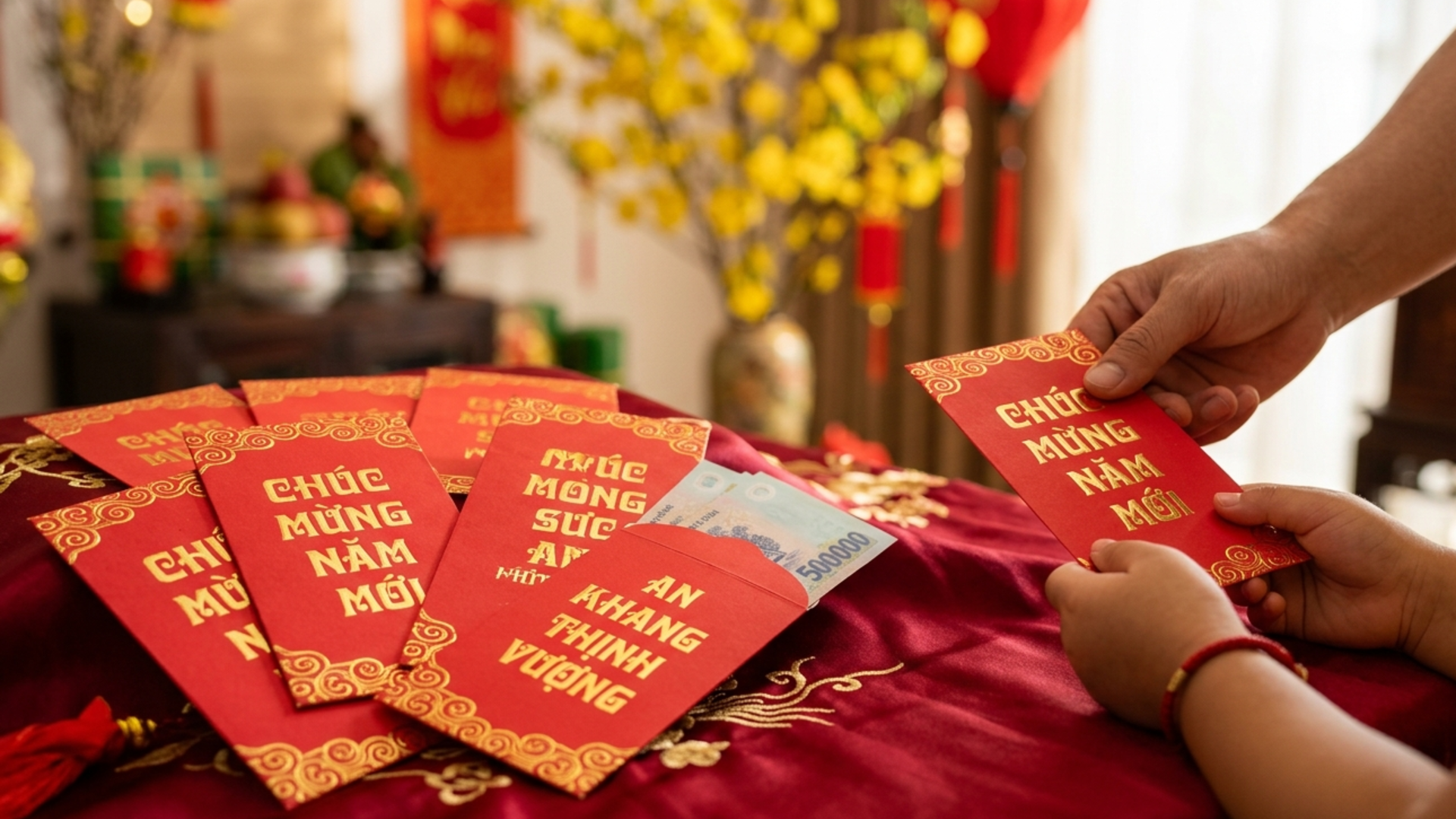
The moment when the entire country dresses in red and yellow is Tết Nguyên Đán, the Lunar New Year. Indeed, it is Vietnam’s biggest holiday, lasting several days and touching everyone from market vendors to government ministers. Meanwhile, transport gets packed, shops close, and families gather.
The signature material symbol of Tết is lì xì — red envelopes with money. Etymologically, the word «lì xì» comes from the Chinese «lì shì» — «profit,» «benefit,» «good fortune.» Typically, these envelopes are bright red, usually printed with gold characters or Vietnamese wishes such as «An Khang Thịnh Vượng» («peace and prosperity»).
Who gives to whom:
- Adults → children (the main scenario).
- Children and grandchildren → elders and parents (a wish for longevity).
- Employers → employees (gratitude for the year).
- Guests → the host family’s children, if you visit during Tết days.
How much to put inside:
- For acquaintances’ children and coworkers’ kids — 20,000 to 100,000 VND (roughly $0.80–4).
- For close relatives — 100,000 to 500,000 VND ($4–20).
- The amount is not the point. The gesture and presentation are.
What to get right:
- Bills must be new and uncreased. Old or wrinkled is disrespectful.
- Avoid amounts containing 4 (homophone with «death» — tử).
- Numbers 6, 8, 9 land well: 66,000, 88,000, 99,000, 188,000, 666,000 VND.
- Receive the envelope with both hands. Do not open it in front of the giver.
If you happen to be in Vietnam during Tết days (usually late January to mid-February) and you are visiting a home, bring a few red envelopes with small bills for the host’s children. Indeed, it counts as good manners and a warm gesture.
5. What to gift to fit the tradition
Thus, a traveler bringing a gift to a Vietnamese friend, business partner, or homestay host can rely on a simple system.
Safe choices:
- Red or gold packaging containing tea, coffee, or sweets. The gift itself can be modest — the wrap does the work.
- A banknote inside a red lì xì envelope — when the occasion fits (Tết, a housewarming, a newborn). Amounts as above.
- Fruit in red wrapping — mandarins, pomelo, dragon fruit. These fruits already carry luck associations.
- Items with the gold star or red ornaments — local crafts from Huế or Hội An.
Better to avoid:
- White or black packaging — mourning colors. A gift in a white box can read as an ill omen.
- Clocks as gifts — the word for «clock» (đồng hồ) in a gift context sounds like the word for «ending» and death. Never.
- Knives, scissors, anything sharp — they «cut» friendship and relationships. If you really want to give a good knife, ask a symbolic coin in return — it lifts the «cut.»
- Handkerchiefs — used at funerals to dab tears. Not for celebrations.
- Mirrors — believed to «reflect luck back away.»
A small cultural note: Vietnamese people rarely open gifts in front of the giver. Therefore, do not be offended if your beautifully wrapped red package gets set aside — it is not indifference but tradition. Instead, it will be opened later, in private.
Why this matters for a traveler
You can vacation in Vietnam without unpacking the symbolism of colors. However, the moment you start noticing it, the trip reads differently. As a result, Vietnamese lucky colors stop being decoration: the red lanterns above the river in Hội An become a wish for luck, the yellow flowers at a café entrance become a promise of prosperity, and the red envelope from a vendor becomes a link in a thousand-year chain stretching from Chinese emperors to your tour.
Therefore, if you want to be in Vietnam at the exact moment the whole country turns red and yellow, plan around Tết — late January or early February on the Gregorian calendar. The Tisland Travel catalog of excursions in Vietnam covers routes across Nha Trang and Da Nang, where the festive atmosphere is most vivid: in temples, on market streets, and in family restaurants where travelers are warmly invited to the table.d: in temples, on market streets, and in family restaurants where travelers are warmly invited to the table.
Tisland Travel has guided travelers across Southeast Asia since 2010. Fifteen years, thousands of trips across Thailand and Vietnam, and our own excursions from Nha Trang and Da Nang.